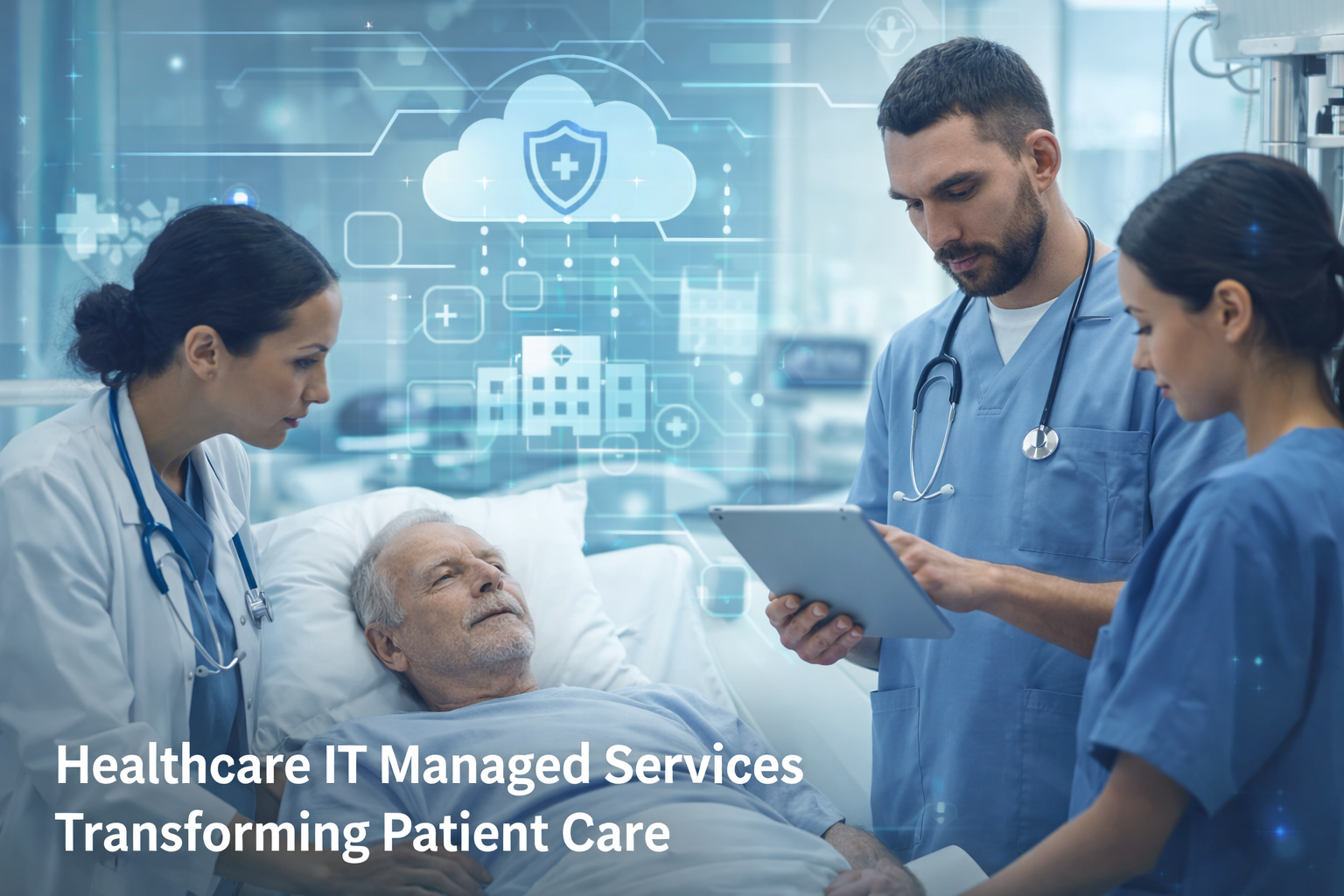
The way Healthcare IT Managed Services Are Helping to Improve Modern Patient Care
ACIPL · Information · 17 Dec 2025
Introduction – What are Healthcare IT managed services?
In today’s healthcare landscape, healthcare IT managed services have become essential. Providers are under pressure to deliver top-quality patient care while managing complex IT environments. These services offer outsourced, healthcare-focused IT support—from infrastructure and end-user support to security and compliance—so providers can stay resilient, secure, and patient-first.
Who can benefit from healthcare IT managed services?
Healthcare IT managed services can benefit hospitals, large clinics, ambulatory care centers, medical practices, and telehealth providers.
Hospital systems at scale
Large hospitals rely on enterprise EHRs, imaging, communications, remote monitoring, and cloud services. They need 24×7 support, high uptime, and strong data security to maintain compliance and continuity.
Small clinics and medical practices
Smaller facilities often lack deep, in-house healthcare IT expertise. Outsourcing provides access to specialists for helpdesk, systems, network, and security operations—at a cost that’s practical.
Telehealth and remote care providers
With telehealth, remote monitoring, and virtual consultations rising, providers need reliable connectivity, secure access, and performant systems. Managed services become the foundation for a stable telehealth ecosystem.
What’s included in healthcare IT managed services?
Typical coverage includes:
- Healthcare IT support (helpdesk, desktops, user troubleshooting)
- Healthcare IT infrastructure management (servers, networks, storage, cloud migration)
- Healthcare security solutions (firewalls, encryption, identity & access management)
- Cloud, backup & disaster recovery (hybrid infrastructure, restore readiness)
- EHR support (platform updates, integrations, app support)
- Healthcare system integration (lab, imaging, billing, interoperability)
- Telehealth IT support (virtual care enablement and monitoring)
Why “managed IT infrastructure” matters
Managed IT infrastructure covers the ongoing management of foundational systems—servers, networks, storage, and cloud architecture. Without a strong base, advanced healthcare digital initiatives can’t perform reliably.
Why healthcare IT managed services are so important
- Better patient experience & operational efficiency: less downtime, faster workflows
- Security & compliance: proactive controls reduce breach and audit risk
- Cost predictability: clearer budgeting vs reactive firefighting
- Scalability & innovation: frees internal teams to focus on transformation
How healthcare IT managed services work in the real world
1) Assessment and onboarding
The provider assesses current infrastructure, network, applications, compliance, and future goals—then maps risks like EHR instability, staffing gaps, or aging hardware.
2) SLA and service definition
SLAs are defined for key metrics like EHR uptime, helpdesk response times, vulnerability patching windows, and backup/recovery objectives.
3) Transition and implementation
Day-to-day monitoring, support, security, cloud operations, and application (including EHR) support begin, with controlled change management for staff adoption.
4) Continuous optimization
Post go-live, the provider continuously monitors performance, strengthens compliance posture, improves processes, and supports expansion (telehealth, remote monitoring, new locations).
When should a healthcare provider adopt managed services?
- Skill shortages: internal IT is over-stretched
- Rapid growth: expansion, mergers, cloud/telehealth adoption
- Security/compliance pressure: audits, incidents, governance needs
- Aging infrastructure: refresh or migration requirements
- Need proactive IT: reduce reactive firefighting and downtime cost
Best practices for successful healthcare IT managed services
- Choose a healthcare-specialized provider familiar with EHRs and clinical workflows
- Define clear scope and measurable KPIs (uptime, response, patch windows)
- Ensure strong backup/DR and network foundations
- Manage change with training and internal+MSP collaboration
- Keep an innovation roadmap (telehealth, monitoring, security maturity)

The real-world impact
- Clinician productivity: fewer IT disruptions and faster workflows
- Patient experience: smoother digital touchpoints and telehealth access
- Lower risk: stronger security and compliance posture
- Cost efficiency: controlled spending and reduced downtime incidents
- Scalability: easier expansion and adoption of new care models
Healthcare IT managed services help providers improve patient care by reducing downtime, strengthening security, and enabling scalable digital operations. If your organization needs reliable IT, compliance-ready security, and 24×7 support—managed services can be a practical, high-impact move.
Want to discuss your healthcare IT requirements? Connect with us via the Contact Us page.